Wednesday, May 7, 2008
SITE IS ON HIATUS
...I am currently working on software to provide detailed, real-time news. Will return in a few weeks....

Wednesday, April 30, 2008
Commentary: How much more relevant is Jeremiah Wright than John Hagee?

Go to Buzzflash original
The Republicans and the MSM tell us the Rev. Wright story deserves huge amounts of attention because Rev. Wright was Obama's pastor.
But let's state a few facts: Obama never solicited Wright's endorsement, McCain worked hard to get Hagee's endorsement.
Obama has been asked over and over and over about Rev. Wright. Only one major MSM reporter, George Stephanopoulos, has asked McCain about Hagee, and even then, McCain never singled out Hagee's anti-Semitic remarks (only his anti-Catholic remarks).
When confronted with their lack of concern for Hagee, the Republicans and the MSM tell us Rev. Wright is important, but they never tell us about the importance of Hagee. Even if you agree that Rev. Wright is more relevant than Rev. Hagee, how much more relevant?
Twice as much? Four times as much? 8? 16?
Since McCain has had one major question on the issue, we can establish a ratio (still can't divide by 0). But the ratio itself stands at about 100,000 to 1. Is that a fair ratio?
more...
Jeff Cohen: Military Propaganda Pushed Me Off TV
The biggest villain here is not Rumsfeld or the Pentagon. It's the TV networks. In the land of the First Amendment, it was their choice to shut down debate and journalism
Go to Huffington Post original
In the fall of 2002, week after week, I argued vigorously against invading Iraq in debates televised on MSNBC. I used every possible argument that might sway mainstream viewers -- no real threat, cost, instability. But as the war neared, my debates were terminated.
In my 2006 book Cable News Confidential, I explained why I lost my airtime:
There was no room for me after MSNBC launched Countdown: Iraq -- a daily one-hour show that seemed more keen on glamorizing a potential war than scrutinizing or debating it. Countdown: Iraq featured retired colonels and generals, sometimes resembling boys with war toys as they used props, maps and glitzy graphics to spin invasion scenarios. They reminded me of pumped-up ex-football players doing pre-game analysis and diagramming plays. It was excruciating to be sidelined at MSNBC, watching so many non-debates in which myth and misinformation were served up unchallenged.
It was bad enough to be silenced. Much worse to see that these ex-generals -- many working for military corporations -- were never in debates, nor asked a tough question by an anchor. (I wasn't allowed on MSNBC unless balanced by at least one truculent right-winger.)
Except for the brazenness and scope of the Pentagon spin program, I wasn't shocked by the recent New York Times report exposing how the Pentagon junketed and coached the retired military brass into being "message-force multipliers" and "surrogates" for Donald Rumsfeld's lethal propaganda.
more...
Go to Huffington Post original
In the fall of 2002, week after week, I argued vigorously against invading Iraq in debates televised on MSNBC. I used every possible argument that might sway mainstream viewers -- no real threat, cost, instability. But as the war neared, my debates were terminated.
In my 2006 book Cable News Confidential, I explained why I lost my airtime:
There was no room for me after MSNBC launched Countdown: Iraq -- a daily one-hour show that seemed more keen on glamorizing a potential war than scrutinizing or debating it. Countdown: Iraq featured retired colonels and generals, sometimes resembling boys with war toys as they used props, maps and glitzy graphics to spin invasion scenarios. They reminded me of pumped-up ex-football players doing pre-game analysis and diagramming plays. It was excruciating to be sidelined at MSNBC, watching so many non-debates in which myth and misinformation were served up unchallenged.
It was bad enough to be silenced. Much worse to see that these ex-generals -- many working for military corporations -- were never in debates, nor asked a tough question by an anchor. (I wasn't allowed on MSNBC unless balanced by at least one truculent right-winger.)
Except for the brazenness and scope of the Pentagon spin program, I wasn't shocked by the recent New York Times report exposing how the Pentagon junketed and coached the retired military brass into being "message-force multipliers" and "surrogates" for Donald Rumsfeld's lethal propaganda.
more...
U.S. report says al-Qaida gaining strength
Go to AP original
WASHINGTON - Al-Qaida has rebuilt some of its pre-Sept. 11 capabilities from remote hiding places in Pakistan, leading to a jump in attacks last year in that country and neighboring Afghanistan, the Bush administration said Wednesday.
Attacks in Pakistan doubled between 2006 and 2007 and the number of fatalities quadrupled, the State Department said in its annual terrorism report. In Afghanistan, the number of attacks rose 16 percent, to 1,127 incidents last year.
The report says attacks in Iraq dipped slightly between 2006 and 2007, but they still accounted for 60 percent of worldwide terrorism fatalities, including 17 of the 19 Americans who were killed in attacks last year. The other two were killed in Afghanistan.
More than 22,000 people were killed by terrorists around the world in 2007, 8 percent more than in 2006, although the overall number of attacks fell, the report says.
more...
WASHINGTON - Al-Qaida has rebuilt some of its pre-Sept. 11 capabilities from remote hiding places in Pakistan, leading to a jump in attacks last year in that country and neighboring Afghanistan, the Bush administration said Wednesday.
Attacks in Pakistan doubled between 2006 and 2007 and the number of fatalities quadrupled, the State Department said in its annual terrorism report. In Afghanistan, the number of attacks rose 16 percent, to 1,127 incidents last year.
The report says attacks in Iraq dipped slightly between 2006 and 2007, but they still accounted for 60 percent of worldwide terrorism fatalities, including 17 of the 19 Americans who were killed in attacks last year. The other two were killed in Afghanistan.
More than 22,000 people were killed by terrorists around the world in 2007, 8 percent more than in 2006, although the overall number of attacks fell, the report says.
more...
The McCain Health Plan: Millions Lose Coverage
Health Costs Worsen, And Insurance And Drug Industries Win
Go to Campaign for America's Future original
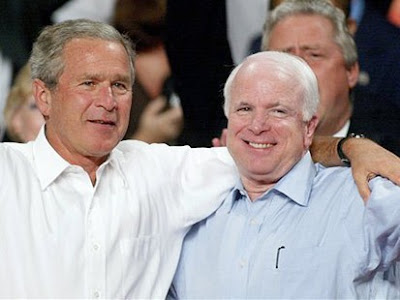
Today Arizona Sen. John McCain will deliver what his handlers are hyping as a major address on health care. McCain’s plan is a dangerous fraud.
He wants voters to think he is going after health care cost inflation. In reality, he wants to dismantle the employer-provided system that now covers over 60 percent (or about 158 million) of non-elderly Americans, forcing millions of us who now get fairly decent health insurance on the job to instead buy whatever they can find on the individual market controlled by unregulated and predatory insurance companies. And he would drive health care costs upward, not downward.
This is truly amazing: McCain and his handlers knew they had to say something about health care. So they turned to their friends (and financial supporters) in the health care industry and the conservative think tanks. And they have adopted the most extreme right-wing ideological approach, premised on the idea that the big problem in health care is that Americans have too much insurance – in their words, we don’t have enough “skin in the game” – and that only when we have to buy health care with money that comes directly out of our own pockets will consumers force doctors, hospitals and insurance companies to become more efficient.
So that’s the theory. But it is contradicted by the facts. Most of us already pay part of our premiums out of our own pockets, and we increasingly have to shell out for co-pays in order to get to see a doctor. The result—in practice—is that most people, even those with good insurance, now think twice or three times about even getting regular preventive health checkups. Having lots of “skin in the game” has meant that millions of Americans don’t get health care they need—and that’s one of the big problems in U.S. health care driving costs up, not down.
But McCain, like George Bush, pays more attention to ultra-conservative theory than he does to the facts. So McCain wants to tax workers’ health care premiums that are paid for by employers. Ask any expert, conservative or liberal, and they will tell you the result will be companies will stop providing health care as an employee benefit. Fortune Magazine quotes one of their experts on the impact of McCain's plan: “I predict that most companies would stop paying for health care in three to four years,” says Robert Laszewski, a consultant who works with corporate benefits managers.
more...

Go to Campaign for America's Future original
Today Arizona Sen. John McCain will deliver what his handlers are hyping as a major address on health care. McCain’s plan is a dangerous fraud.
He wants voters to think he is going after health care cost inflation. In reality, he wants to dismantle the employer-provided system that now covers over 60 percent (or about 158 million) of non-elderly Americans, forcing millions of us who now get fairly decent health insurance on the job to instead buy whatever they can find on the individual market controlled by unregulated and predatory insurance companies. And he would drive health care costs upward, not downward.
This is truly amazing: McCain and his handlers knew they had to say something about health care. So they turned to their friends (and financial supporters) in the health care industry and the conservative think tanks. And they have adopted the most extreme right-wing ideological approach, premised on the idea that the big problem in health care is that Americans have too much insurance – in their words, we don’t have enough “skin in the game” – and that only when we have to buy health care with money that comes directly out of our own pockets will consumers force doctors, hospitals and insurance companies to become more efficient.
So that’s the theory. But it is contradicted by the facts. Most of us already pay part of our premiums out of our own pockets, and we increasingly have to shell out for co-pays in order to get to see a doctor. The result—in practice—is that most people, even those with good insurance, now think twice or three times about even getting regular preventive health checkups. Having lots of “skin in the game” has meant that millions of Americans don’t get health care they need—and that’s one of the big problems in U.S. health care driving costs up, not down.
But McCain, like George Bush, pays more attention to ultra-conservative theory than he does to the facts. So McCain wants to tax workers’ health care premiums that are paid for by employers. Ask any expert, conservative or liberal, and they will tell you the result will be companies will stop providing health care as an employee benefit. Fortune Magazine quotes one of their experts on the impact of McCain's plan: “I predict that most companies would stop paying for health care in three to four years,” says Robert Laszewski, a consultant who works with corporate benefits managers.
more...
7% of Americans marry for health insurance

Go to Los Angeles Times original
WASHINGTON — Some people marry for love, some for companionship and others for status or money. Now comes another reason to get hitched: health insurance.
In a poll released Tuesday, 7 percent of Americans said they or someone in their household decided to marry in the past year so they could obtain health care benefits via their spouse.
"It's a small number, but a powerful result, because it shows how paying for health care is reflected not only in family budgets, but in life decisions," said Drew Altman, president of the Kaiser Family Foundation, which commissioned the survey as part of its regular polling on health care.
The survey found that the costs of health care outranked housing expenses, rising food prices and credit card bills as a source of concern.
Of those surveyed, 28 percent said they had experienced serious problems because of the cost of health care, nearly tied with 29 percent who had problems getting a job or a raise.
Gasoline prices were the top economic worry, with 44 percent saying they had serious problems keeping up with increases at the pump.
Health care inflation has been rising at about twice the rate of economic growth.
Therefore, it may be no surprise that nearly one-fourth of Americans decided to keep or change jobs in the past year because of health insurance.
more...
GM losses widen as US market flags
Go to Financial Times original
General Motors on Wednesday reported a wider net loss of $3.3bn for the first quarter as the flagging US car market and problems at GMAC, its financing arm, and Delphi, its biggest supplier, took their toll.
Revenue for the quarter was $42.7bn, down slightly from $43.4bn a year ago, as the problems facing its US business failed to offset strong growth of its business in China, Brazil, Russia and India.
more...
General Motors on Wednesday reported a wider net loss of $3.3bn for the first quarter as the flagging US car market and problems at GMAC, its financing arm, and Delphi, its biggest supplier, took their toll.
Revenue for the quarter was $42.7bn, down slightly from $43.4bn a year ago, as the problems facing its US business failed to offset strong growth of its business in China, Brazil, Russia and India.
more...
New U.S. carrier in Gulf a "reminder" to Iran: Gates
Go to Reuters original
MEXICO CITY (Reuters) - The U.S. Navy has temporarily added a second aircraft carrier in the Gulf as a "reminder" to Iran, but this was not an escalation of American forces in the region, U.S. Defense Secretary Robert Gates said on Tuesday.
Speaking to reporters during a trip to Mexico, Gates flatly denied a suggestion that the presence of two U.S. carriers in the Gulf could be a precursor to military action against Tehran.
"This deployment has been planned for a long time," Gates said. "I don't think we'll have two carriers there for a protracted period of time. So I don't see it as an escalation. I think it could be seen, though, as a reminder."
He declined to elaborate on his remarks and provided no details about the deployment.
Pentagon spokesman Geoff Morrell said the second carrier arrived in the Gulf on Tuesday to replace one on duty that was expected to depart the region in two days.
more...
MEXICO CITY (Reuters) - The U.S. Navy has temporarily added a second aircraft carrier in the Gulf as a "reminder" to Iran, but this was not an escalation of American forces in the region, U.S. Defense Secretary Robert Gates said on Tuesday.
Speaking to reporters during a trip to Mexico, Gates flatly denied a suggestion that the presence of two U.S. carriers in the Gulf could be a precursor to military action against Tehran.
"This deployment has been planned for a long time," Gates said. "I don't think we'll have two carriers there for a protracted period of time. So I don't see it as an escalation. I think it could be seen, though, as a reminder."
He declined to elaborate on his remarks and provided no details about the deployment.
Pentagon spokesman Geoff Morrell said the second carrier arrived in the Gulf on Tuesday to replace one on duty that was expected to depart the region in two days.
more...
Jesse Jackson urges Haiti debt relief

Go to Reuters original
PORT-AU-PRINCE, April 29 (Reuters) - U.S. civil rights leader Jesse Jackson called for urgent debt relief for Haiti on Tuesday to ease the burden of a food crisis that sparked violent protests in the impoverished Caribbean nation earlier this month.
Jackson said Haiti owed the World Bank and the Inter-American Development Bank about $1.5 billion, with debt service payments reaching some $70 million a year.
"We want this debt canceled and the people relieved of its burden," Jackson told a news conference at the presidential palace following a meeting with President Rene Preval.
"That money can be used and invested in roads, schools, bridges, health, houses and education," Jackson said.
He also vowed to help mobilize food assistance for poor Haitians, stung by rising prices and already low living standards in a country where most people survive on less than $2 per day.
Jackson spoke as he wound up a three-day fact-finding visit to Haiti. The visit was prompted by a recent week of riots and looting over food prices in which at least six people were killed.
Prices of Haitian staples such as rice, beans, wheat, flour, corn and cooking oil have at least doubled during the past six months.
The outspoken civil rights leader, who has made several trips to Haiti in the past, said U.S. lawmakers needed to declare "an emergency alert" on behalf of their Caribbean neighbor.
more...
White House undermines EPA on cancer risks, GAO says

Go to AP original
WASHINGTON -- The Bush administration is undermining the Environmental Protection Agency's ability to determine health dangers of toxic chemicals by letting nonscientists have a bigger - often secret - role, congressional investigators say in a report obtained by The Associated Press.
The administration's decision to give the Defense Department and other agencies an early role in the process adds to years of delay in acting on harmful chemicals and jeopardizes the program's credibility, the Government Accountability Office concluded.
At issue is the EPA's screening of chemicals used in everything from household products to rocket fuel to determine if they pose serious risk of cancer or other illnesses.
A new review process begun by the White House in 2004 is adding more speed bumps for EPA scientists, the GAO said in its report, which will be the subject of a Senate Environment Committee hearing Tuesday. A formal policy effectively doubling the number of steps was adopted two weeks ago.
Cancer risk assessments for nearly a dozen major chemicals are now years overdue, the GAO said, blaming the new multiagency reviews for some of the delay. The EPA, for example, had promised to prepare assessments on 10 major toxic chemicals for external peer review by the end of 2007, but only two reached that stage.
GAO investigators said extensive involvement by EPA managers, White House budget officials and other agencies has eroded the independence of EPA scientists charged with determining the health risks posed by chemicals.
The Pentagon, the Energy Department, NASA and other agencies - all of which could be severely affected by EPA risk findings - are being allowed to participate "at almost every step in the assessment process," said the GAO.
more...
US watchdog presses for mortgage rescues
Go to Financial Times original
The US should fight the housing crisis by using low-cost government loans to help borrowers pay down unaffordable mortgages, Sheila Bair, one of the country’s top banking regulators, proposes.
Writing in the Financial Times on Wednesday, Ms Bair, chairman of the Federal Deposit Insurance Corporation, says the new government loans should cover up to 20 per cent of the value of the existing mortgages.
These loans, which would be interest-free for the first five years, would be used to pay down part of the existing mortgage. In return for the cash, lenders would reduce payments on the remaining part of the mortgage to affordable levels, defined as a proportion of income. They would also pay a fee to cover the government’s funding costs over the initial five-year period.
“Voluntary loan modifications have helped but it is not enough,” Ms Bair told the FT in an interview.
She said her plan allows the government “to leverage its lower borrowing costs to significantly reduce foreclosures with no expansion of contingent liabilities and very little net cost”.
more...
The US should fight the housing crisis by using low-cost government loans to help borrowers pay down unaffordable mortgages, Sheila Bair, one of the country’s top banking regulators, proposes.
Writing in the Financial Times on Wednesday, Ms Bair, chairman of the Federal Deposit Insurance Corporation, says the new government loans should cover up to 20 per cent of the value of the existing mortgages.
These loans, which would be interest-free for the first five years, would be used to pay down part of the existing mortgage. In return for the cash, lenders would reduce payments on the remaining part of the mortgage to affordable levels, defined as a proportion of income. They would also pay a fee to cover the government’s funding costs over the initial five-year period.
“Voluntary loan modifications have helped but it is not enough,” Ms Bair told the FT in an interview.
She said her plan allows the government “to leverage its lower borrowing costs to significantly reduce foreclosures with no expansion of contingent liabilities and very little net cost”.
more...
Powering Down the Patriot Act
In the wake of another damaging report detailing the bureau's abuse of its data-gathering power, Congress is seeking to limit the use of national security letters

Go to Mother Jones original
There's a move afoot on Capitol Hill to rein in some of the vast powers conferred upon government investigators by the Patriot Act, the infamous, hastily crafted law written in response to the 9/11 attacks. New legislation has been introduced in both houses of Congress intended to curb the FBI's ability to collect private data on virtually anybody using a tool called a national security letter (NSL). The bills come in the wake of yet another damaging FBI inspector general report on the bureau's abuse of its expanded authorities.
"The privacy of American citizens is a core value in our society," said Sen. Sheldon Whitehouse (D-R.I.), a former federal prosecutor and member of the Senate Judiciary Committee, at an April 23 hearing on the FBI's use of NSLs. "I think this is our next really big civil liberties issue."
And addressing that issue may start with a bill, sponsored by Sen. Russ Feingold (D-Wisc.), which would both drastically limit the circumstances under which these secretive orders are issued and strictly regulate how the information obtained is handled by the FBI.
more...

Go to Mother Jones original
There's a move afoot on Capitol Hill to rein in some of the vast powers conferred upon government investigators by the Patriot Act, the infamous, hastily crafted law written in response to the 9/11 attacks. New legislation has been introduced in both houses of Congress intended to curb the FBI's ability to collect private data on virtually anybody using a tool called a national security letter (NSL). The bills come in the wake of yet another damaging FBI inspector general report on the bureau's abuse of its expanded authorities.
"The privacy of American citizens is a core value in our society," said Sen. Sheldon Whitehouse (D-R.I.), a former federal prosecutor and member of the Senate Judiciary Committee, at an April 23 hearing on the FBI's use of NSLs. "I think this is our next really big civil liberties issue."
And addressing that issue may start with a bill, sponsored by Sen. Russ Feingold (D-Wisc.), which would both drastically limit the circumstances under which these secretive orders are issued and strictly regulate how the information obtained is handled by the FBI.
more...
Time Warner to spin off cable arm
Go to Financial Times original
Time Warner on Wednesday confirmed plans to spin off its 84 per cent stake in Time Warner Cable, as the US media group delivered first-quarter earnings that narrowly missed Wall Street expectations because of falling sales at its AOL internet division.
Jeff Bewkes, chief executive since January, said however that “underlying operating strength” in its cable, networks and film businesses during the quarter “gave us the confidence to reaffirm our full-year business outlook.”
The group continues to expect 2008 full-year growth in adjusted operating income before depreciation and amortisation to be between 7 and 9 per cent.
Although expected tax benefits from the Economic Stimulus Act will boost free cash flow to “at or above” $4.5bn, Time Warner maintained its target for earnings from continuing operations, which it expects to fall in the range of $1.07 to $1.11 per share.
“We’ve decided that a complete structural separation of Time Warner Cable, under the right circumstances, is in the best interests of both companies’ shareholders,” Mr Bewkes said.
more...
Time Warner on Wednesday confirmed plans to spin off its 84 per cent stake in Time Warner Cable, as the US media group delivered first-quarter earnings that narrowly missed Wall Street expectations because of falling sales at its AOL internet division.
Jeff Bewkes, chief executive since January, said however that “underlying operating strength” in its cable, networks and film businesses during the quarter “gave us the confidence to reaffirm our full-year business outlook.”
The group continues to expect 2008 full-year growth in adjusted operating income before depreciation and amortisation to be between 7 and 9 per cent.
Although expected tax benefits from the Economic Stimulus Act will boost free cash flow to “at or above” $4.5bn, Time Warner maintained its target for earnings from continuing operations, which it expects to fall in the range of $1.07 to $1.11 per share.
“We’ve decided that a complete structural separation of Time Warner Cable, under the right circumstances, is in the best interests of both companies’ shareholders,” Mr Bewkes said.
more...
Albert Hofmann, father of drug LSD, dies in Switzerland
Go to AP original
GENEVA - Albert Hofmann, the father of the mind-altering drug LSD whose medical discovery inspired — and arguably corrupted — millions in the 1960s hippie generation, has died. He was 102.
Hofmann died Tuesday at his home in Burg im Leimental, said Doris Stuker, a municipal clerk in the village near Basel where Hofmann moved following his retirement in 1971.
For decades after LSD was banned in the late 1960s, Hofmann defended his invention.
"I produced the substance as a medicine. ... It's not my fault if people abused it," he once said.
more...
GENEVA - Albert Hofmann, the father of the mind-altering drug LSD whose medical discovery inspired — and arguably corrupted — millions in the 1960s hippie generation, has died. He was 102.
Hofmann died Tuesday at his home in Burg im Leimental, said Doris Stuker, a municipal clerk in the village near Basel where Hofmann moved following his retirement in 1971.
For decades after LSD was banned in the late 1960s, Hofmann defended his invention.
"I produced the substance as a medicine. ... It's not my fault if people abused it," he once said.
more...
Tuesday, April 29, 2008
Obama strongly denounces former pastor (video & full story)
Go to Reuters original
WINSTON SALEM, North Carolina (Reuters) - Democratic presidential candidate Barack Obama denounced his former pastor in his strongest language to date on Tuesday, saying he was outraged by Rev. Jeremiah Wright's assertions about the U.S. government and race.
"His comments were not only divisive ... but I believe that they end up giving comfort to those who prey on hate," Obama told reporters.
"Whatever relationship I had with Reverend Wright has changed as a consequence of this," Obama said.
Obama was forced to address the issue again after another appearance on Monday by Wright to combat criticism of his controversial sermons that have, among other things, suggested the United States deserved some blame for the September 11 attacks and had had a hand in spreading AIDS to blacks.
"At a certain point if what somebody says contradicts what you believe so fundamentally and then he questions whether or not you believe it -- in front of the National Press Club -- then that's enough," Obama said, referring to Wright's suggestion that Obama's denouncement was what a politician had to say.
"That's a show of disrespect to me. It is also, I think, an insult to what we've been trying to do" on the campaign, he said.
more...
Afghanistan's insurgency spreading north
Militant attacks are increasing outside the Taliban's southern stronghold, such as Sunday's on President Hamid Karzai
Go to Christian Science Monitor original
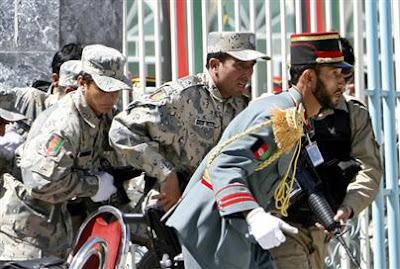
KABUL, AFGHANISTAN - The attempted assassination of President Hamid Karzai Sunday came as the latest sign of a trend worrying Western officials: that the insurgency is spreading from the Taliban stronghold of the south to the central and northern regions of the country.
The militant attack, the biggest in Kabul since mid-March, came during a public ceremony. Despite a massive security presence, militants managed to fire bullets and rockets at the president, killing two nearby lawmakers and a boy.
The insurgency in Afghanistan has not been "contained," Director of National Intelligence Michael McConnell testified before a Senate subcommittee in February. "It's been sustained in the south, it's grown a bit in the east, and what we've seen are elements of it spread to the west and the north."
A recent study by Sami Kovanen, an analyst with the security firm Vigilant Strategic Services of Afghanistan, echoed this assessment. He reported 465 insurgent attacks in areas outside the restive southern regions during the first three months of 2008, a 35 percent increase compared with the same period last year. In the central region around Kabul there have been 80 insurgent attacks from January through March of this year, a 70 percent jump compared to the first three months of last year.
The numbers are part of a nationwide trend of rising violence. In the southern and southeastern provinces, including the insurgent hotbeds of Kandahar and Helmand, guerrilla attacks spiked by 40 percent, according to Mr. Kovanen's research.
more...

Go to Christian Science Monitor original
KABUL, AFGHANISTAN - The attempted assassination of President Hamid Karzai Sunday came as the latest sign of a trend worrying Western officials: that the insurgency is spreading from the Taliban stronghold of the south to the central and northern regions of the country.
The militant attack, the biggest in Kabul since mid-March, came during a public ceremony. Despite a massive security presence, militants managed to fire bullets and rockets at the president, killing two nearby lawmakers and a boy.
The insurgency in Afghanistan has not been "contained," Director of National Intelligence Michael McConnell testified before a Senate subcommittee in February. "It's been sustained in the south, it's grown a bit in the east, and what we've seen are elements of it spread to the west and the north."
A recent study by Sami Kovanen, an analyst with the security firm Vigilant Strategic Services of Afghanistan, echoed this assessment. He reported 465 insurgent attacks in areas outside the restive southern regions during the first three months of 2008, a 35 percent increase compared with the same period last year. In the central region around Kabul there have been 80 insurgent attacks from January through March of this year, a 70 percent jump compared to the first three months of last year.
The numbers are part of a nationwide trend of rising violence. In the southern and southeastern provinces, including the insurgent hotbeds of Kandahar and Helmand, guerrilla attacks spiked by 40 percent, according to Mr. Kovanen's research.
more...
Families tell lawmakers of heparin deaths

Go to AP original
WASHINGTON (AP) — The widow of a man who died after receiving contaminated heparin told a congressional subcommittee Tuesday "we have a false sense of security" in a land where people expect to be protected and safe.
Brushing away tears, Johanna Marie Staples of Toledo, Ohio, said her husband, Dennis, was looking forward to his 60th birthday party on the last day of his life.
Contaminated heparin, a blood thinner used in dialysis and other treatments, has been connected to 81 deaths and 785 severe allergic reactions, said Rep. Bart Stupak, D-Mich., chairman of the House Energy and Commerce subcommittee on oversight and investigations.
The heparin, made from ingredients imported from China, has been recalled by Baxter International and the Food and Drug Administration has blocked imports from the Chinese company.
The FDA found the drug was contaminated with oversulfated condroitin sulfate, which mimics heparin and thus was not detected in routine testing, Stupak noted.
When it was introduced into the product has not yet been determined.
more...
Subscribe to:
Posts (Atom)